Introduction: Airtel’s Enduring Presence
Bharti Airtel has been around since 1985, long before mobile phones became essential. Now operating in 18 countries, it remains a major force in India with a 33% market share as of December 2023. It’s faced heavy competition—especially since Jio’s arrival—but hasn’t backed down. With Xstream, Airtel has stepped into OTT, and its quiet move into Airtel OTT bundling reflects a broader play to lock in users through content and convenience. Here’s a closer look, minus the corporate fluff.
Airtel in the Telecom Arena: Surviving the Jio Juggernaut
The Indian telecom industry is a battlefield where only the resilient survive. Airtel, with its extensive 5G, 4G, and LTE Advanced services, has managed to hold its ground despite fierce competition. As of December 2023, Airtel commanded a 33% share of the wireless subscriber market, trailing Reliance Jio’s 39.7% but still serving over a billion mobile subscribers across India. The company’s 35% share of the rural telecom market further underscores its reach, connecting urban techies and rural farmers alike.
Strategic Moves in Telecom
Airtel’s survival strategy hinges on premiumisation—catering to customers who value quality over cutthroat pricing. This approach has paid dividends, with Airtel’s Average Revenue Per User (ARPU) reaching Rs 245 per month, notably higher than Jio’s Rs 203 and Vodafone Idea’s Rs 163. The company has also been aggressive in its 5G rollout, with 120 million subscribers migrated to 5G by late 2024, though it lags behind Jio’s 170 million. Airtel’s tariff hikes—30-50% in 2019, 20% in 2021, and another in July 2024—have bolstered its financials, generating Rs 292 billion in free cash flow in the first nine months of FY25, up from Rs 213 billion in FY24.
Airtel’s innovative “minutes factory” model, which outsources all but marketing, sales, and finance, has allowed it to scale efficiently. The company has also deleveraged significantly, prepaying Rs 670 billion in spectrum debt since FY22, reducing its net debt to Rs 392 billion against an annualized EBITDA of Rs 1.04 trillion. These financial maneuvers suggest Airtel is not just surviving but positioning itself for long-term growth.
Table: Airtel’s Telecom Metrics (As of December 2023)
| Metric | Value |
|---|---|
| Wireless Market Share | ~33% |
| Rural Telecom Market Share | ~35% |
| ARPU | Rs 245/month |
| 5G Subscribers | 120 million |
| Free Cash Flow (FY25, 9M) | Rs 292 billion |
| Net Debt | Rs 392 billion |
Source: The Bharti Airtel story – Indian Express
Airtel OTT Bundling: Xstream and the Streaming Smorgasbord
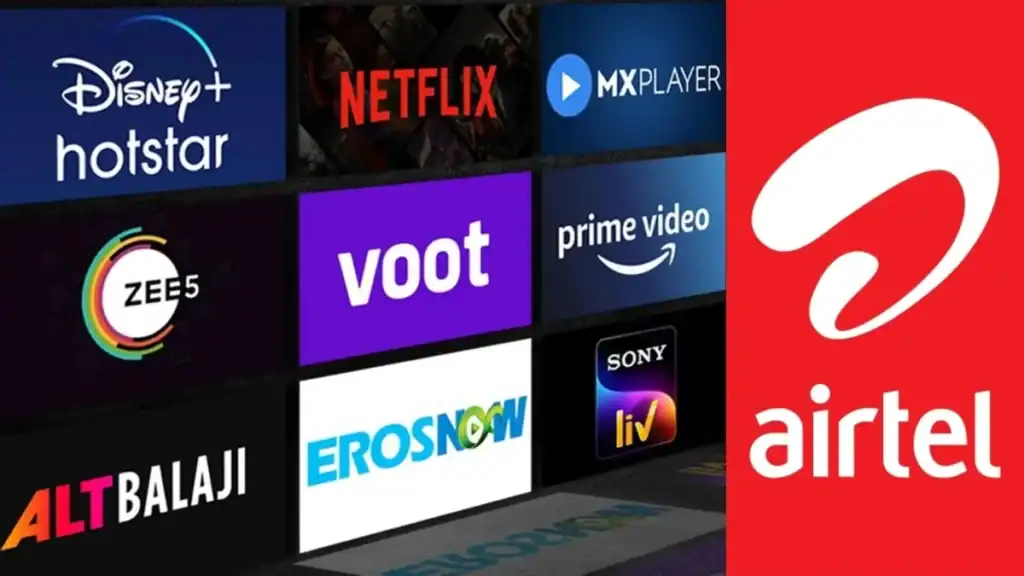
As India’s appetite for digital content grows—projected to reach a market size of USD 3.21 billion by 2030 with a CAGR of 13.45%—Airtel has cleverly pivoted to capture this trend. Enter Airtel Xstream, a platform that aggregates content from over 25 OTT services, including Netflix, JioHotstar, Zee5, SonyLiv, and regional players like Hoichoi and Manorama Max. Launched as a “streaming super app,” Xstream offers a unified experience across mobile apps, desktops, and smart TVs, making it a one-stop shop for entertainment.
Xstream’s Offerings
Airtel’s OTT strategy is less about creating original content and more about bundling existing platforms into attractive packages. For instance, its prepaid plans starting at ₹279 per month provide access to a bouquet of OTT services worth ₹750, alongside unlimited 5G data and calls. Higher-tier plans, like the ₹598 pack with 28-day validity or the ₹1729 pack with 84-day validity, cater to heavy streamers. Broadband users also benefit, with plans like the Entertainment package (₹999/month, 200 Mbps) including access to JioHotstar and Amazon Prime, while the Infinity plan (₹3999/month, 1 Gbps) throws in Netflix Premium.
Table: Airtel Xstream OTT Plans (As of May 2025)
| Pack Type | Benefits | Validity | MRP | Notes |
|---|---|---|---|---|
| Direct Xstream Play Subscription | Netflix Basic, JioHotstar, Zee5, Xstream Premium | 1 month | ₹279 | – |
| Prepaid Content Only Pack | Netflix Basic, JioHotstar, Zee5, Xstream Premium | 1 month | ₹279 | Includes 1GB data |
| Prepaid Data Bundle (Unlimited 5G) | Netflix Basic, JioHotstar, Zee5, Xstream Premium | 28 days | ₹598 | Includes unlimited 5G data and calls |
| Prepaid Data Bundle (Unlimited 5G) | Netflix Basic, JioHotstar, Zee5, Xstream Premium | 84 days | ₹1729 | Includes unlimited 5G data and calls |
Source: Airtel introduces all-in-one OTT entertainment packs – Airtel
Strategic Partnerships
Airtel’s OTT success relies on partnerships with major platforms, ensuring a diverse content library that spans 16 languages and includes international blockbusters, Bollywood hits, and regional shows. Unlike competitors like Disney+ Hotstar (25.65% market share in 2024) or Amazon Prime Video (21.27%), Airtel Xstream doesn’t compete directly on content creation but takes advantage of its telecom infrastructure to distribute these services. This aggregator model simplifies the fragmented OTT landscape, where over 40 platforms vie for attention, and addresses consumer pain points like multiple subscriptions and payment hassles.
In a fragmented digital entertainment space, Airtel’s bundling approach is similar to how electronics brands adapt their retail strategies to meet evolving consumer expectations. It’s not just about selling a product—it’s about packaging an ecosystem.
Impact and Future Outlook
Airtel’s dual focus on telecom and OTT is a masterclass in customer retention. By bundling connectivity with entertainment, Airtel ensures users stay within its ecosystem, reducing churn in a market where loyalty is as fleeting as a viral TikTok. The company’s DTH arm, with 17.6 million subscribers and a 29% market share, further strengthens its position, especially as it explores a potential merger with Tata Play to target high-paying households.
Airtel’s resilience in the face of Jio’s disruption echoes the playbooks of challenger brands like Noise, which rose by leveraging affordability and aspirational tech—a perfect example of clever positioning in saturated markets.
Financially, Airtel is on solid ground, with projections of a 15% revenue CAGR and 19% EBITDA CAGR from FY24 to FY27. Its free cash flow is expected to reach Rs 1.3 trillion over the same period, fueled by tariff hikes and a growing subscriber base. In the OTT space, while Airtel’s market share as an aggregator is harder to quantify, its ability to offer value-added services positions it well in a market projected to grow to USD 12.5 billion by 2030.
A Sarcastic Nod to Airtel’s Ambition
Airtel is positioning itself as more than a network—it’s becoming a digital habit. With OTT bundles, 5G access, and aggressive packs, it’s quietly tightening its grip on everyday entertainment. Jio may be louder, but Airtel is definitely in the room.
Much like how FabIndia connects emotionally with India’s cultural pulse, Airtel positions itself as not just a service provider, but a lifestyle brand woven into entertainment, connectivity, and everyday habits.
Airtel isn’t just selling connectivity—it’s building trust. The brand even positions itself as a spam-fighting network that “protects, not just connects.”
All Sources
- Statista – Mobile Telecom Market Share in India
- Statista – Market Share by Company (Duplicate)
- Airtel – All-in-One OTT Packs for Prepaid Users
- Statista – OTT Video Market in India
Related Reads: